
It Is Not Too Late to Learn to Read
If your child with Williams syndrome is 12, 15, or 18 and still cannot read—or cannot read well—please hear this:
Their opportunity to become a reader has not expired.
If your child with Williams syndrome is 12, 15, or 18 and still cannot read—or cannot read well—please hear this:
Their opportunity to become a reader has not expired.
If your child with Williams syndrome is 12, 15, or 18 and still cannot read—or cannot read well—please hear this:
Their opportunity to become a reader has not expired.
 As the Education Consultant for the WSA, I have the opportunity to support many families as they navigate the special education system. Usually, this is exciting as I get to meet teachers and teams and help them understand how to teach their students with Williams syndrome (WS). Usually, this is the case. But, last week was hard. Last week, I spoke with several families whose kiddos weren’t reading or had made very limited progress over the last several years.

The learner with Williams syndrome (WS) can be both the biggest joy and the biggest challenge for the educators charged with their instruction. Students with Williams syndrome are often caring, engaging, and excited learners. They also have a unique learning profile which requires educators to teach to the student and allow him or her to access their curriculum in unique ways.
COVID-19 has dramatically changed the landscape of school in general and special education in particular. Schools may be face-to-face, hybrid, virtual, or some combination of all of those things. IEP meetings are conducted over zoom and service provision for therapies and social work has completely changed.
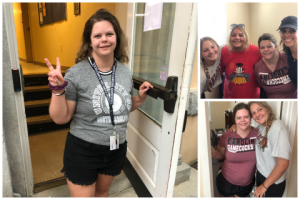
Joelle Packard recently embarked on a new journey and moved into her dorm to start the college program CarolinaLIFE at University of South Carolina.
We understand that school closures and social distancing can be hard for kids to understand, and difficult for caregivers who are suddenly in the role of “teacher.”
If you attended the convention in Summer 2018, you may have had the opportunity to interact with representatives from Think College. The organization is part of the Institute for Community Inclusion at the University of Massachusetts Boston, and they work with families to help navigate the exciting and complicated process of considering college options for our daughters and sons with Williams syndrome.
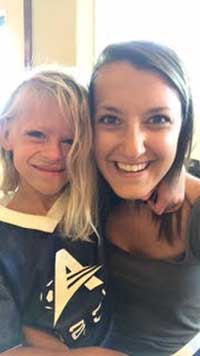 Back to school for many WS families can be exciting, yet filled with much anxiety about the variety of learning obstacles our kiddos face on a daily basis. For our family, upon learning the diagnosis of our oldest daughter Stella (diagnosed at 5), we elected to actively seek out a school district and school that would rise our daughter up to her fullest potential.
Do you have a vision for your child with Williams syndrome? Is it written down so you can refer to it, update it, and remember exactly why you are working so hard every day to overcome the obstacles in your child’s path? Lisa and Ned Portune read all the things that their child...“probably wouldn’t do," and then set out to help Erin be the very best she could be.